
Attachment, a Solution or Conundrum?
I am in no way an expert in physiology and psychology, as a matter of fact I can distinctly recall why I chose to study maths and “logic”. It was simply because I could follow a maths argument as it was never too far from the fundamental axioms and postulates that underpin it (at-least at the level that I studied). Psychological conjectures on the other hand are always underpinned by metaphors & similarities; as it turns out you have a lot of wiggle room to interpret them and that is something my mind outrightly rejects as a wishful proofs. Physiology, well we don’t understand it well enough to concretely conclude if it can be explained by fundamental truths that we know so far. In both cases we rely heavily on abstraction to explain the phenomenons that we observe and its a necessity when explaining abstract phenomenon like attachments.
Try explaining the concept of attachment to a robot, machine, AI, or even an infant. You can associate it with food, people, places, memories, fragrances, sounds, time etc.; Then you have to explain the “degree” to which you’re attached or the “type” of attachment that you have associated with “it” and maybe there are even more variables at play. Personally, I would describe it as an involuntary association felt with a concreta or abstracta.
Did evolution hardcode attachment? To answer this we have to look at evolutionarily older part of our brain called the limbic system (thank you Google). This is what defines our species-typical behaviour manages survival instinct, regulates emotions and forms behaviour shaping memories. I wouldn’t have bothered writing down the specific names and functions of its components but it might help associate some linkages for those amongst you who are curious. The Amygdala, think of it as one who gives opinions on if something is worth giving any importance at all. The Hippocampus, think of it as a short buffer for your memories and it eventually files them to long term memory storage. The Hypothalamus, its your control for oxytocin release, the hormone responsible for developing attachments and then there is Basal Ganglia enforcing recurring behaviours through the release of feel good hormone, dopamine.
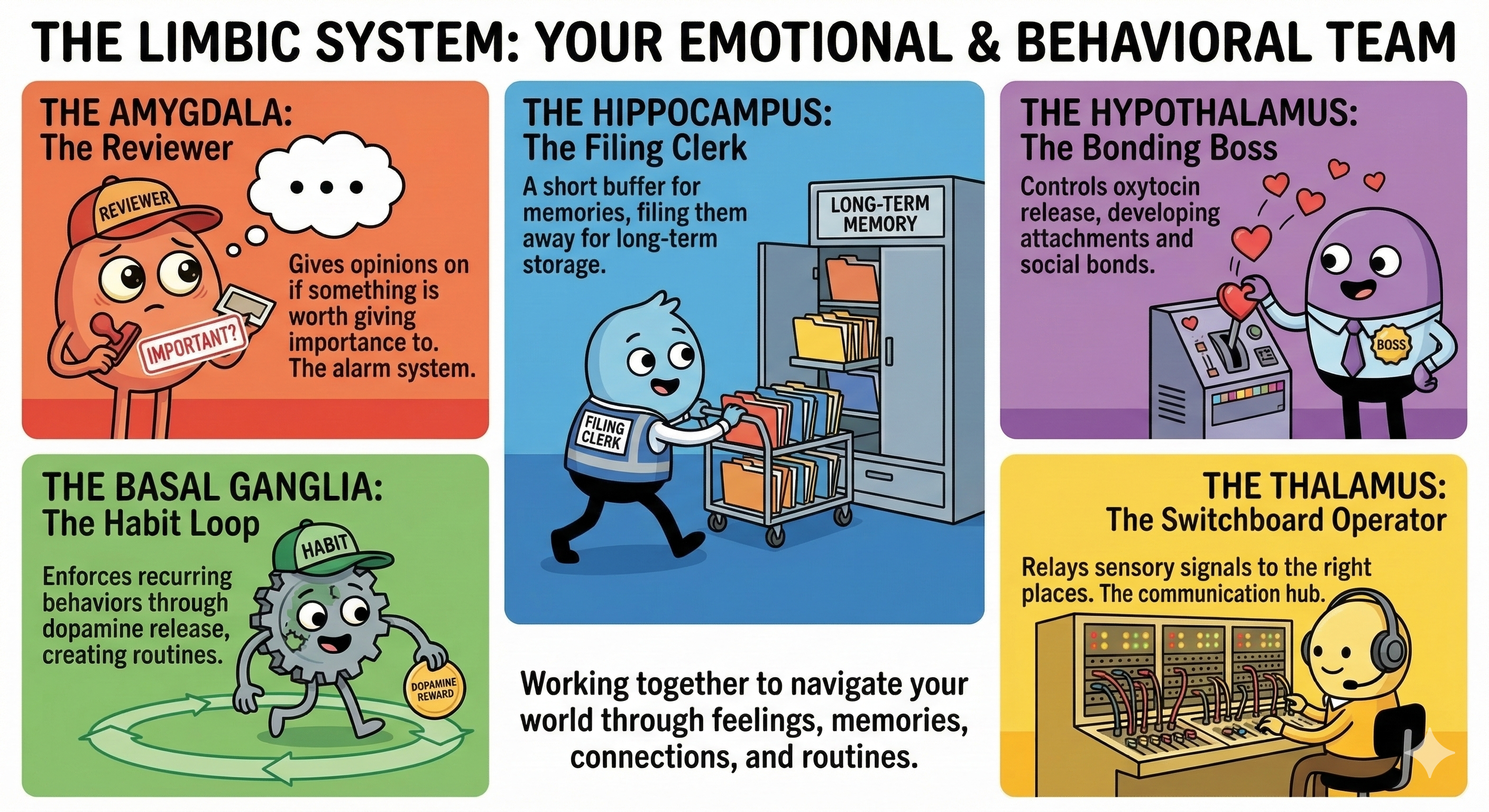
So at a very basic level you are attached to anything because a bunch of chemicals were release at specific times based on your interpretation of the situation. I might be wrong in my interpretation of the following so take it with a grain of salt. If a memory was stored because of oxytocin, its possibly more meaningful than a memory or habit associated with shear repetition because of dopamine release. Both of these mechanisms evolved in our species for situational reasons, dopamine reinforces our habits which feel rewarding (and are generally required for survival, like hunting, eating etc.). Oxytocin strengthens our bonds and relationships to everything around us, It might’ve evolved as a survival mechanism to bond us into packs but as social beings we developed a tonne of other emotions based on our interactions.
There is a tiny little caveat, all this is dependent on our interpretation of the situation and sometimes that is beyond our control. For example, what happens if you suddenly found out that your idol is not as good as you once thought. Depending on how strong was your previous attachment with that person, it might be a hard pill to swallow. This is because years of oxytocin reinforces your likeness towards your idol and it wouldn’t just vanish in the blink of an eye. In fact, you might want this to be false and that’s your brain trying to find oxytocin and relief. I will lean into psychology to try and understand how we react to disruption in our most strongly held attachments.
Our trait of cooperation for survival delivers this feeling of “trust” that rests our senses on being in company of another being or just proximity to an object or place. Our lowered guard is vulnerable and on being “attacked” at our most exposed moment insinuates an involuntary fight or flight response. A flight response is equivalent to ignorance, an attempt to flee the situation by forgetting about it and suppressing in the memory. A fight response is equivalent to being reactive about the event and giving an expressing your emotions. Sometimes it might be a mix of the two and either of it is a completely natural response; none superior over the other. Its just your personality dealing with a blow.
Returning to the title, is it a problem if we develop attachments? No, on the contrary its a feeling that you cherish in life. Humans literally evolved to feel attachments and they are beneficial at the most fundamental level but that doesn’t mean that we have to live with them forever. A detachment can be thought of as your new interpretation of truth one which outweighs your previous beliefs. As a slave to logic, here is my understanding of detachment, “I understand that upon discovery of new information or developments, your view of the situation needs to evolve instantaneously but its only human that we choose to ignore it based on the chemical inertia of our hormones. Choosing to ignore or fighting back with misinformation to the obvious truth is a logical fallacy that is bound to succumb.”